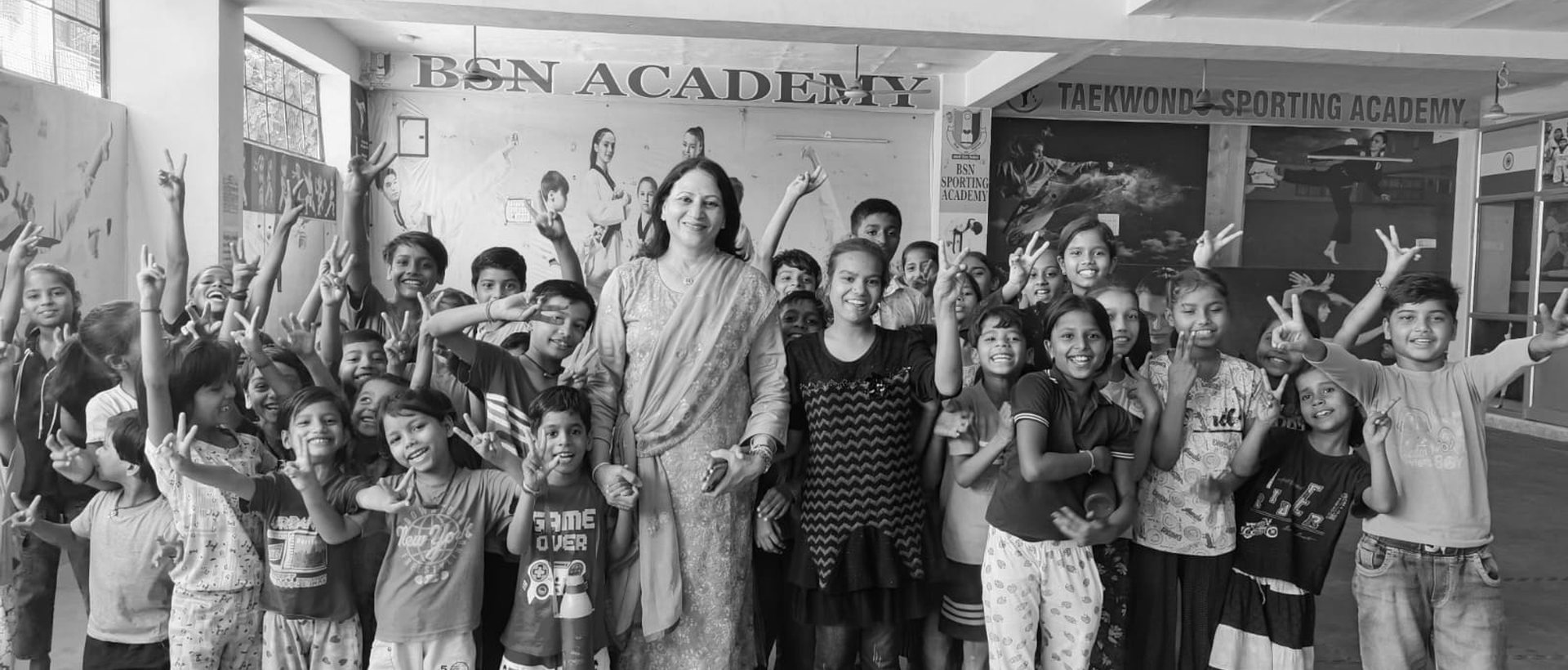
Many live in densely populated settlements where families survive on irregular daily wages, homes are overcrowded, basic services are uncertain, and a quiet or safe place to study is often unavailable. Poverty, migration, family instability, poor nutrition, gender discrimination and limited access to quality public services can affect every part of a child's development.
“Education is not a privilege. It is a fundamental right.”
Introduction
For these children, school enrolment alone does not guarantee education. A child may be enrolled but attend irregularly because the family relocates, a parent loses work, a younger sibling needs care, or the child is expected to help earn an income. Others struggle because they have no books, digital device, internet access or adult support at home. Repeated absence and weak foundational learning gradually make lessons harder, confidence lower and dropout more likely.
In urban slums, childhood can quickly become overshadowed by survival. Children who should be learning may be pushed towards street vending, domestic work, small workshops, waste collection, family businesses or household responsibilities. Adolescent girls may face additional barriers linked to safety, domestic duties and early marriage. Without timely academic and emotional support, a temporary learning gap can become permanent exclusion from education.
Every child deserves the opportunity to learn, grow and dream, regardless of the lane they live in, the income their family earns or the circumstances into which they were born.
Educational Challenges Where We Work
The following state-level indicators from Uttar Pradesh, Bihar and Rajasthan reflect the wider conditions of poverty, child labour and weak foundational learning. For children living in urban slums, these challenges are often intensified by migration, insecure housing, overcrowding, limited learning resources and unstable family income.
Indicator Uttar Pradesh Bihar Rajasthan
People living in multidimensional poverty
Child workers (5–14 years) 8,96,301 4,51,590 2,52,338
Children (2–4 years) attending pre-school 30.4% 42.9% 38.2%
Women with 10+ years of schooling 42.5% 33.1% 33.7%
Std II children who can read words 44.4% 30.6% 21.4%
Std II children who can recognise numbers up to 99
Fig. 1 — Challenges faced by children in urban slum communities
What Multidimensional Poverty Looks Like in Urban Slums
access and parents who may be unable to support schoolwork.
delayed access to healthcare.
- Education deprivation: irregular attendance, weak foundational skills, lack of books, limited digital
- Health deprivation: poor nutrition, recurring illness, unsafe water, inadequate sanitation and
- Living-standard deprivation: cramped one-room homes, insecure electricity, unsafe surroundings,
- Economic insecurity: dependence on daily wages, unstable employment, debt and the constant risk
- Social vulnerability: migration, lack of continuity in schooling, gender-based restrictions, safety
Why These Challenges Matter
Behind every statistic is a child with ability, curiosity and dreams. Yet children in urban slum communities often begin school already carrying disadvantages that other children do not face. They may enter classrooms without pre-school exposure, struggle to recognise letters or numbers, miss lessons because of family movement, and return to homes where there is neither time nor space for revision.
When families are struggling to pay for food, rent, medicines and transport, education can appear to be a cost rather than a pathway out of poverty. A child who falls behind may be labelled weak, lose confidence and stop attending regularly. Over time, school dropout, child labour, exploitation and early marriage become real risks.
This is where Pehal Sanstha steps in.
Through free learning resources, remedial education, activity-based teaching, academic mentoring, school enrolment support and continuous encouragement, we help children remain connected to learning. We work not only to improve marks, but also to rebuild confidence, protect childhood and create pathways towards independence.
Education Breaks the Cycle
Every child who stays in school is one child less vulnerable to child labour, exploitation, early marriage and intergenerational poverty.
P R O G R A M M E A Baal Aarambh — Pre-School Programme
Building Bright Futures from the Very First Step
The early years of a child's life shape language, confidence, behaviour and readiness for school. However, many young children in urban slums grow up in overcrowded homes with limited space for play, few ageappropriate books or toys, and little exposure to structured early learning. Parents working long or irregular hours may have limited time to engage them in rhymes, stories or school-readiness activities.
Some children spend the day with older siblings or neighbours while parents work. Others enter primary school without having attended pre-school, making it difficult to follow classroom routines, communicate confidently or understand basic concepts.
Through our Baal Aarambh Programme, Pehal Sanstha provides children aged 2.5 to 6 years with a safe, joyful and stimulating learning environment. We use play-based methods so that learning begins with curiosity rather than pressure.
Parents are not asked to purchase books, workbooks, worksheets, colours or basic learning material. We provide these resources so that a family's financial condition does not decide whether a child can participate.
- Comprehensive teaching and revision of all subjects according to the Rajasthan Board curriculum.
- Special focus on concept clarification and strengthening weak foundational areas.
- Chapter-wise explanations, summaries and structured revision plans.
- Individual doubt-clearing and remedial-support sessions.
- Regular worksheets, assignments and question-practice exercises.
- Preparation through previous years' papers, sample papers and expected question formats.
- Periodic tests and mock examinations conducted in a board-exam environment.
- Detailed feedback to help students identify mistakes and improve their performance.
- Guidance on answer presentation, stepwise writing, diagrams and proper use of examination time.
- Additional support for students who have missed classes or are academically behind.
- Stress-management, confidence-building and continuous motivation before examinations.
- Regular communication with parents regarding attendance, progress and areas requiring
- Interactive worksheets and ready-to-use teaching-learning material.
- Storytelling, educational games and practical demonstrations.
- Activity-based methods that simplify difficult concepts.
- Remedial support for children who have fallen behind.
- Individual guidance, doubt-clearing and encouragement to participate.
- Support that complements teachers' efforts and helps address mixed learning levels.
- Door-to-door visits and community outreach in vulnerable neighbourhoods.
- Identification of out-of-school children and children with irregular attendance.
- Conversations with parents to understand financial, social and practical barriers.
- Guidance and encouragement to help families prioritise school enrolment and continuity.
- Academic and emotional support that helps children catch up after absence.
- Regular motivation, activity-based learning and personal attention to rebuild confidence.
Be the Reason a Child Never Gives Up on Education
For a child living in an urban slum, the absence of a notebook, a quiet study space or timely academic support can become the reason for falling behind. What begins as a small learning gap can grow into repeated failure, irregular attendance, dropout and pressure to work.
At Pehal Sanstha, every worksheet we design, every workbook we distribute, every classroom we support and every child we mentor is part of a larger effort to protect childhood and keep education within reach.
Your Support Helps Us Provide
Education is more than reading and writing. It is protection from exploitation, a pathway away from child labour, the confidence to make choices and the foundation of long-term independence.
Your contribution can help a child choose a classroom over labour, a workbook over worry and a future of possibilities over a childhood limited by poverty.
- Free books, workbooks, worksheets, stationery and learning material.
- Qualified educators and regular remedial classes.
- Play-based early childhood education and school-readiness support.
- Activity-based and digital learning for better understanding.
- Individual mentoring, confidence building and career guidance.
- School enrolment, retention and community awareness support.
- A safe and encouraging learning environment where children are treated with dignity.
“One child. One classroom. One future at a time.”
Join Pehal Sanstha in taking education from access to dignity — Shiksha Se Samman Tak.